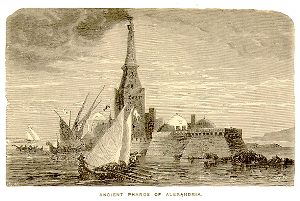
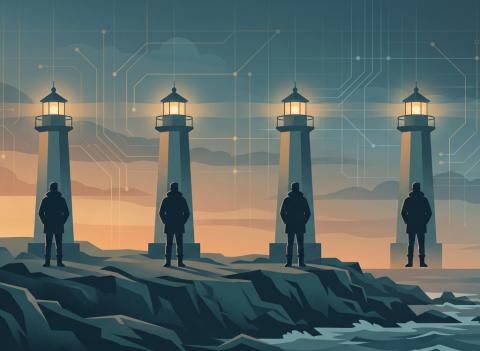
You ask an AI to write you a story. It hands you a lighthouse keeper named Elias. You try a different app, a different day, a different prompt. Same guy. Same lighthouse.
If that's ever creeped you out, you're not imagining it, and you're not alone. Researchers just proved it with numbers.
The Pattern Nobody Asked For
In 2026, a Cornell research team ran a simple test. They asked four major AI models, including Claude, Gemini, ChatGPT, and an open-source model called OLMo, to just "write a story." No topic, no characters, no constraints. They did this 20,000 times.
The results were almost identical across the board:
- 88.3% of all 20,000 stories contained one of just 11 recurring words
- Those words were mostly names (Elias, Mara, Elara) and jobs (keeper, baker, mayor, clockmaker, fisherman, librarian, conductor)
- Over half the stories included a lighthouse
- The exact combo of "Elias the lighthouse keeper" showed up in roughly two out of every three stories
Some researchers have gone further, breaking down individual model behavior: one analysis claims Elias alone appeared in about 26.5% of stories, with the word "keeper" showing up in 48.1%. One claim floating around is even more specific: that 56% of Claude's generated stories carried the identical title "The Lighthouse Keeper's Secret". Striking if true, but that granular a number needs its own source check before you repeat it as fact.
Either way, the headline number holds up across multiple independent reports: nine out of ten AI "surprise me" stories are not surprising at all.
It's Not Because Old Books Are Full of Lighthouse Keepers
The obvious guess is that AI just learned this from literature. Maybe "Elias the lighthouse keeper" is some overused trope buried in the classics, and the AI is just parroting what it read.
The researchers checked. It's not that.
They searched the actual training data the models learned from, and Elias, Elara, and "lighthouse keeper" barely show up. There's no famous novel, no folk tale, no viral fanfic driving this. When they cross-checked one model's alignment data specifically, only a tiny sliver, about 3.8% of nearly 79,000 sample stories, contained any of these words at all.
So the AI isn't remembering something it read a lot. It's manufacturing a habit almost out of nothing.
So What's Actually Going On
Here's the plain-language version, no jargon.
After an AI model is built, companies run it through a second training phase to make it safer and more polished. Human reviewers look at pairs of AI answers and pick which one they like better. The model learns from those choices.
Two things go wrong here:
People tend to reward the familiar. When a reviewer sees two decent stories, one weird and original, one comfortable and predictable, they usually pick the comfortable one. That's just how human judgment works. Multiply that preference across thousands of ratings, and the model learns: familiar wins, weird loses.
Companies also train the model to avoid risk. No copyrighted characters. No real celebrities. No adult content. No violence. That rules out huge chunks of what makes human stories interesting. What's left over is a small, boring, totally safe zone: pre-industrial jobs, quiet coastal settings, gentle old-fashioned names. A lighthouse keeper checks every box. He's not owned by Disney. He's not going to offend anyone. He's the empty, safe default.
Once a model tries "Elias" once and it gets a good rating, that choice becomes more likely next time. And the time after that. Researchers who study this mathematically describe it as a snowball effect: whichever safe, familiar answer gets picked slightly more often at the start ends up dominating almost completely, not because it's better, but because early small preferences compound and crowd out every other option. It's less "the AI has a favorite name" and more "the training process only leaves room for one name to survive."
This effect has a name: mode collapse. The AI technically has near-infinite creative range. In practice, training squeezes that range down to a narrow, repeatable set of "safe" defaults, and Elias is what's sitting at the bottom of that funnel.
It's Not Staying Inside the Chatbot Anymore
This stopped being a fun quirk once it left the chat window.
"Elias Thorne" has now shown up as the credited author of self-published books on Amazon, including at least one on alternative cancer treatments. He's turned up as the fake "artist" on AI-generated ambient music tracks. Google search interest in his name was basically flat until late 2025, then spiked sharply once people started noticing and talking about it.
That matters for a simple reason: the internet is what future AI models will be trained on next. If AI keeps flooding the web with Elias stories, the next generation of models may learn Elias from the internet itself, turning a training-side glitch into a permanent fixture of AI culture. Researchers are already working on fixes, things like forcing a model to generate several different options at once instead of its single "safest" guess, which measurably increases variety. But right now, the loop is still running.
The Takeaway
Elias isn't a joke, an Easter egg, or proof the AI has personality. He's a visible symptom of how AI training quietly narrows creative choices down to whatever is safest and most familiar, across every major AI company at once.
- The pattern is measured, not anecdotal: 88.3% of 20,000 test stories hit the same 11 words
- It's not from old books. Pre-training data does not explain it
- It comes from the safety and polish phase of training, where "familiar and risk-free" gets rewarded over "original"
- It's already leaking into real books, music credits, and search trends
- Every time you see Elias and a lighthouse in the same paragraph, you're looking at a seam in how the model was built, not a coincidence
Have you run into Elias, Elara, or the lighthouse yourself? Reply and tell me which AI tool it was and what you asked for. I'll be collecting examples to see how widespread this really is.
Sources
- Hamilton, S. and Mimno, D., "Elias in the Lighthouse, Again? Diagnosing Low Diversity in LLM Stories", Cornell / arXiv, 2026 (the core 20,000-story study)
- "Chatbots Keep Telling Stories About Lighthouse Keeper 'Elias Thorne'. We Might Know Why", 404 Media
- "Why Do Chatbots Keep Telling Stories About Someone Named 'Elias Thorne'?", Gizmodo
- "The Strange Case of Elias Thorne, the Imaginary Man AI Chatbots Are Obsessed With", Vice
- "The curious case of Elias Thorne, and what he tells us about AI inbreeding", The Guardian
- "The 2025 Name of the Year is Elara", Namerology (naming-trend context for why "Elara" specifically resonates)
- "Dr. Elara Voss, LLMs' own Jungian archetypal memory?", West Coast Stat Views / Harvard TagTeam